WYSIWYG editors have always saved developers from writing raw HTML by hand. But in 2026, the bar has moved: the editors worth your attention are no longer just rich text tools; they are AI content platforms. The question is no longer “does it have a spell checker?” but “can it draft, refine, translate, and review content without your team ever leaving the editor?”
To help you navigate that question, this article compares two leading JavaScript WYSIWYG editors: Froala (now on v5.1) and CKEditor 5 (now on v48+). Both have shipped major AI features in the past year, and both have evolved their pricing models substantially. Here is what you need to know in 2026.
Key Takeaways
- Both Froala and CKEditor 5 now offer built-in AI capabilities, but with different strengths.
- Froala focuses on flexible, provider-agnostic AI workflows with predictable flat-rate pricing.
- CKEditor 5 provides a more mature enterprise AI ecosystem, including AI Chat, AI Review, and advanced collaboration features.
- Froala is typically faster to integrate and includes unlimited users and editor loads on paid plans.
- Choose Froala for simplicity, flexibility, and cost predictability; choose CKEditor 5 for collaboration-heavy enterprise workflows and advanced document management.
What Are Froala and CKEditor 5?
Froala is a lightweight, JavaScript WYSIWYG HTML editor built for developers. It now powers AI-assisted content workflows through its new AI Assist plugin (introduced in v5.1, April 2026), which brings in-editor AI chat, tone adjustment, and translation, all without leaving the editor. It integrates natively with Filestack for file management and supports 15+ frameworks, including React, Angular, and Vue.
CKEditor 5 is a modern, TypeScript-based rich text editor built on an MVC architecture. In late 2025, it launched CKEditor AI, described at release as the industry’s first AI co-writer built natively into a rich text editor, covering AI Chat, AI Review, AI Quick Actions, and AI Translate. It also introduced a Long-Term Support (LTS) edition in October 2025, targeting enterprises that need multi-year stability.
Froala vs CKEditor 5 Feature Comparison
Let’s take a look at the features of both of these:
| Feature |
Froala (v5.1, 2026) |
CKEditor 5 (v48+, 2026) |
| Basic formatting (bold, italic, headings, lists, alignment, etc.) |
Yes |
Yes |
| Tables |
Yes |
Yes |
| Customizations |
Yes |
Yes |
| AI Writing Assist |
AI Assist plugin — in-editor chat popup, tone adjustment, translation, content expansion. Connects to OpenAI, self-hosted models, or your own backend. |
CKEditor AI — multi-turn AI Chat, AI Review (grammar, clarity, tone), AI Quick Actions (rewrite, summarise, tone change), AI Translate. Supports OpenAI, Anthropic, Google Gemini, Azure OpenAI, Amazon Bedrock, and custom LLMs. |
| AI content interception/workflow API |
Yes — intercept AI responses before insertion, trigger analytics, launch AI from custom UI. |
Yes — programmatic API for AIReview, full AI integration layer for rich text output validation. |
| Track Changes |
Yes — text, formatting, images, tables |
Yes — now tracks GHS elements/attributes as suggestions too |
| Paste from Office |
Word and Excel |
Word, Excel, and Google Docs (with enhanced paste, preserving styles, lists, and tables) |
| Spelling and Grammar |
Spell checker |
Both spelling and grammar (AI-powered grammar/clarity via CKEditor AI) |
| Image insertion (URL) |
Yes |
Yes |
| Drag and drop image uploads |
Yes — reposition, resize, align, link, replace, or delete |
Yes |
| Embed media |
Yes |
Yes |
| Auto-save |
Yes |
Yes |
| Export to PDF |
Yes |
Yes |
| Export to Word |
Yes |
Yes (including import from Word with comments and suggestions preserved) |
| API |
Powerful JavaScript API |
RESTful Cloud Services APIs + programmatic AI API |
| Equation support |
Equation symbols + third-party plugins |
MathType integration |
| Real-time collaboration |
No |
Yes — comments, suggestions, revision history |
| Email editing |
No |
Yes — responsive WYSIWYG email editor (launched April 2025) |
| Auto-direction (RTL/LTR) |
Yes — auto-detects keyboard input |
No |
| Automatic text transformation |
No |
Yes |
| Security |
XSS defence mechanism |
Content Security Policy (CSP) support |
| Accessibility compliance |
Yes |
Yes |
| Image Manager |
Yes — browse, insert, delete images on your server |
No |
| File management |
Filestack integration — CDN, storage, AI image enhancements |
CKBox add-on (separate pricing) |
| LTS / stability edition |
No dedicated LTS edition |
Yes — CKEditor 5 LTS Edition (up to 3 years, since Oct 2025) |
| Framework support |
15+ frameworks (React, Angular, Vue, and more) |
Native Angular, React, Vue; modern npm/TypeScript setup |
| Merge fields (mail merge) |
No |
Yes |
| Footnotes |
No |
Yes |
| Multilingual UI |
30+ languages |
38+ professionally translated languages |
AI Features: A Closer Look
AI is the defining battleground for WYSIWYG editors in 2026, and both products have shipped meaningfully, though with different philosophies.
Froala AI Assist (v5.1, launched April 2026) is built around zero context-switching. Two toolbar buttons give users an interactive AI popup and a one-click “Quick Action” dropdown. The plugin is deliberately provider-agnostic: you connect it to OpenAI, DeepSeek, a self-hosted model, or your own backend.
Froala published tutorials for integrating AI Assist with WordPress + DeepSeek and with Google’s Gemini. The plugin ships with a full workflow API, letting developers intercept AI responses before they are inserted into the editor, fire analytics events post-insertion, or launch the AI popup programmatically from anywhere in their UI.
CKEditor AI launched in November 2025 and has since expanded considerably. It covers AI Chat (multi-turn conversations with context-awareness, file uploads, and URL pasting), AI Review (grammar, clarity, and tone checks with reviewable inline suggestions), AI Quick Actions (one-click rewrites, summaries, tone shifts), and AI Translate.
A notable architectural advantage: CKEditor AI is not just a prompt wrapper; it includes an AI integration layer that instructs LLMs to produce valid HTML output and understand document structure. The May 2026 update added first-class support for Azure OpenAI, Amazon Bedrock, and Google Vertex AI with no custom adapter work required, plus OpenTelemetry observability. CKEditor AI is priced as a usage-based add-on (see Pricing below).
Edge: CKEditor 5’s AI feature set is more mature and enterprise-ready at this point, with deeper LLM integrations, observability, and a reviewable-suggestion workflow. Froala’s AI Assist is newer but more developer-flexible, particularly for teams building custom AI workflows into their products. Selecting between such specialized feature sets often requires context from our list of the best WYSIWYG editors in 2026 to see how other industry leaders compare.
Pricing: Froala vs CKEditor 5 in 2026
Now, let’s talk about the pricing.
Froala (2026)
Froala maintains an annual subscription and perpetual license model. Current plans (pricing subject to active discounts; Froala frequently runs 20–30% off promotions):
| Plan |
Annual Subscription (approx.) |
| Free |
$0 |
| Professional |
~$899/year |
| Enterprise |
~$1,999/year |
| Architect |
Contact sales |
All paid plans include unlimited editor loads and unlimited users, a key differentiator versus per-load pricing models. The AI Assist plugin is available on paid plans. Froala also maintains its perpetual license option for teams that prefer a one-time purchase.
CKEditor 5 (2026)
CKEditor 5 has moved to a usage-based model centred on editor loads, with AI priced separately as an add-on:
| Plan |
Annual Subscription (approx.) |
| Free |
$0 |
| Essential |
~$1728/year |
| Professional |
~$3,468/year |
| Custom |
Contact sales |
CKEditor AI is a paid add-on on top of these plans, priced by AI operations (100M / 400M / 800M unit tiers), starting at ~$133/month (annual). Export to PDF and Word are included in Essential and above. CKBox (file management) and Image Optimiser are additional add-ons priced separately.
Pricing verdict: Froala’s flat annual pricing is more predictable, especially for products with high editor load volumes. CKEditor 5’s usage-based model can become expensive at scale when AI, collaboration, and file management add-ons are stacked. For small-to-mid projects, CKEditor’s free plan and Essential tier are competitive entry points, but enterprise deployments should model the total cost of add-ons carefully.
Documentation and Support
Both editors have strong documentation in 2026.
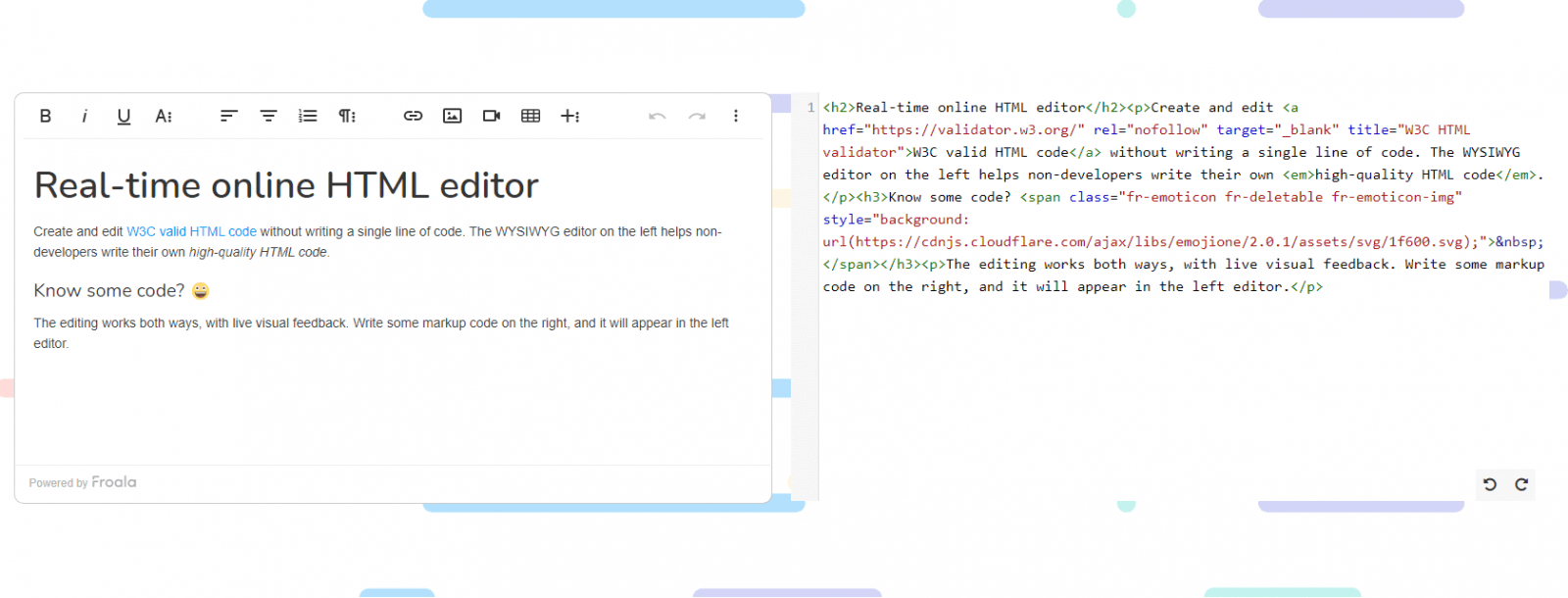
Froala provides Quick Start Guides with code snippets, framework-specific plugin guides, a help centre with FAQs, full API documentation, and an online HTML editor for trying features without downloading. Support is available via email, phone, and the Froala support portal. Platinum Support (priority handling, live screen sharing, emergency fixes) is available as an upgrade.
CKEditor 5 provides developer guides, feature references, API documentation, online demos, tutorials, migration guides, and FAQs. It also publishes detailed changelogs and an active GitHub community. The LTS Edition comes with guaranteed support and a dedicated account manager on Custom plans.
Edge: Roughly even. Froala users note that documentation is clear but could use more in-depth video tutorials for advanced framework scenarios. CKEditor 5’s documentation depth matches its larger feature surface area. Balancing these documentation styles against actual feature depth and support models is essential, as detailed in our Froala vs CKEditor comparison.
Ease of Use and Integration
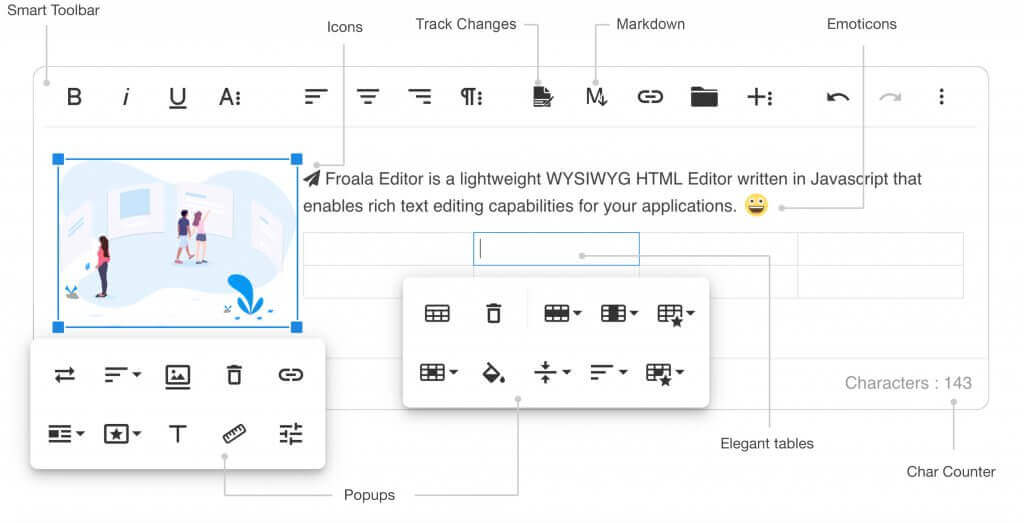
Froala remains one of the fastest editors to integrate, initialisation in as low as 40ms, clean and intuitive Smart Toolbar grouping 100+ features into four categories. The free online editor lets teams evaluate without setup. The AI Assist plugin requires setting aiSupplementalTermsAccepted: true in the configuration for explicit consent, then connecting to your AI provider.
CKEditor 5 went through a major modernisation in 2025–2026, deprecating its predefined builds in favour of a unified npm/TypeScript installation method (finalised in v48). While this modernisation improves long-term maintainability, teams upgrading from older CKEditor setups face a migration step. The online builder still works for evaluating configurations quickly.
Edge: Froala for new integrations. CKEditor 5 for teams already invested in its ecosystem who want the richest feature set.
Which WYSIWYG Editor Should You Use in 2026?
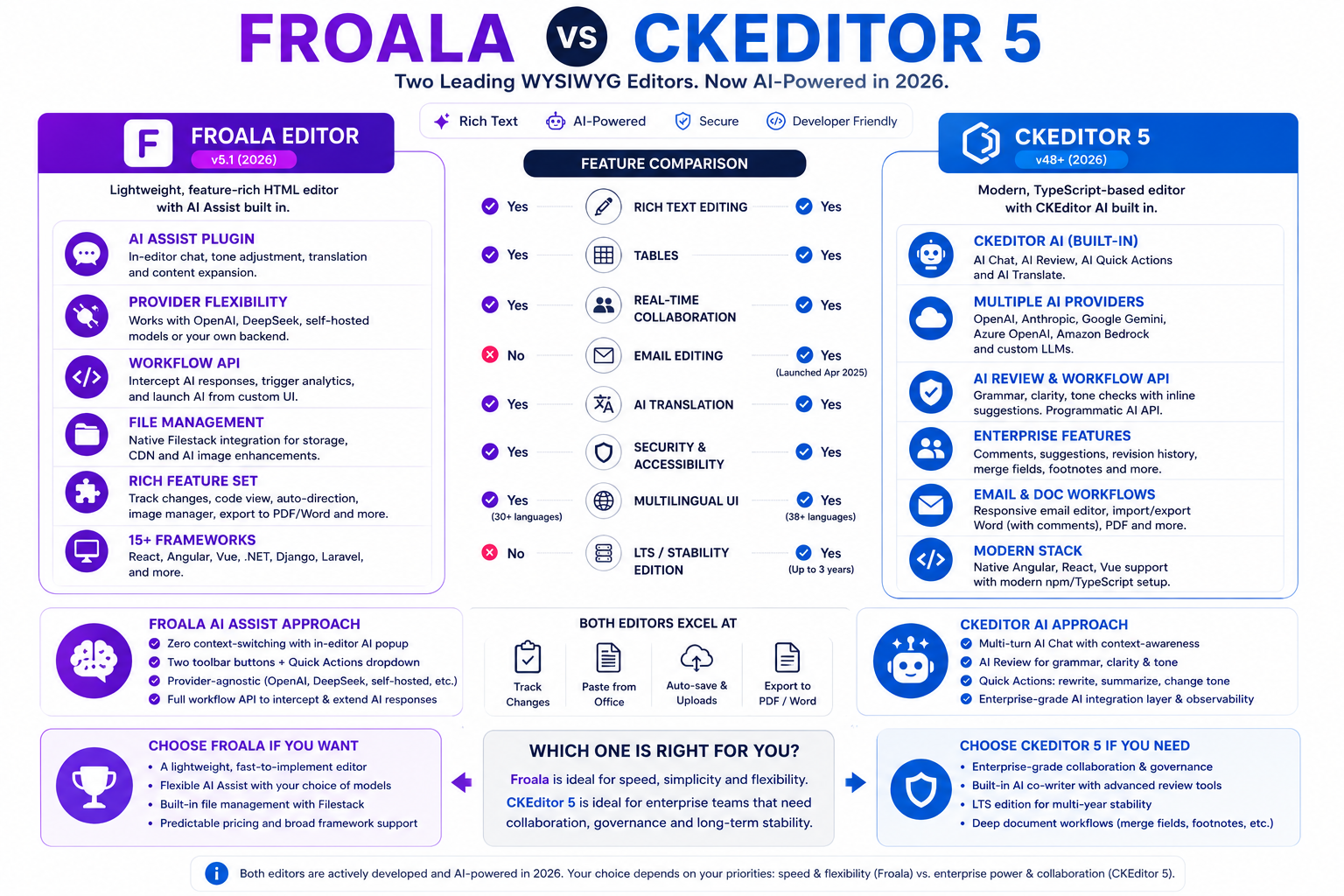
The right choice depends on what you are building:
Choose Froala if:
- You want predictable flat-rate licensing with unlimited users and editor loads.
- You are building a product where AI is an enhancement to the editing experience and want full control over the AI provider and workflow.
- Fast integration across 15+ frameworks is a priority.
- You need RTL/LTR auto-detection or a built-in image manager.
- You prefer a perpetual license option.
Choose CKEditor 5 if:
- Real-time collaboration, comment threads, and revision history are core requirements.
- You need the most mature AI co-writing feature set (AI Chat, Review, Translate with multi-LLM support).
- You are building in a regulated enterprise environment and need the LTS Edition for long-term stability.
- Your team produces responsive emails from within the editor.
- You need Word import with comments and suggestions preserved.
For most product teams in 2026, Froala edges ahead on value and developer simplicity, particularly with the new AI Assist plugin making AI features accessible without a separate paid add-on tier. CKEditor 5 is the stronger choice for content-heavy enterprise platforms where real-time collaboration and deep AI review workflows justify the additional cost. While CKEditor 5 focuses on complex enterprise workflows, our Froala vs Simditor comparison highlights how the latter’s lightweight nature serves developers seeking an even more streamlined editing experience.
Ready to test an AI-powered editor in your own app? Start your free Froala trial and see how quickly you can add rich text editing, AI Assist, file management, and developer-friendly customization to your project.
Pricing and features are current as of June 2026. Always verify current pricing at cart.froala.com and ckeditor.com/pricing before purchasing.